


Exercise Classes for Back and Joint Pain in Cardiff: Supervised Group Exercise - Back2Basics


Written by Patrick Walsh MChiro, GCC registered chiropractor, The Cardiff Chiropractors
Musculoskeletal (MSK) pain classes are small, supervised exercise sessions that help people with muscle and joint pain build strength, mobility and confidence at a pace that suits their current ability.
If pain has made you wary of exercise, or you are not sure where to start, a class can give you guidance, a routine and company without expecting you to "push through".
At The Cardiff Chiropractors, our Back2Basics MSK classes run at the St Mellons clinic. They are led by Patrick, who is also an experienced personal trainer and a provider for the Wales National Exercise Referral Scheme (NERS). This guide covers what the research says, what happens in a class, what it costs, and whether a group suits you better than one-to-one rehabilitation.

What Are Exercise Classes for Back and Joint Pain?
Back2Basics is specially designed exercise classes for joint and back pain in Cardiff. They are small group sessions, supervised by a qualified clinician, that uses progressive strength, mobility and balance work to help people manage musculoskeletal pain.
MSK stands for musculoskeletal: the muscles, joints, tendons and ligaments that move the body.
Back2Basics runs at our St Mellons clinic and is designed especially for adults aged 50 and over. It also suits anyone with general back pain, stiff hips and knees, joint pain or reduced mobility, and anyone who feels unsure about returning to exercise. Places are limited so that everyone can be watched, corrected and progressed.
Why Does Back or Joint Pain Make Everyday Tasks Harder?
Pain can make everyday tasks harder because people in pain tend to move less, and moving less gradually reduces strength, stamina and confidence.
The pattern builds slowly. Someone with a sore back stops carrying the heavy shopping, then walks less, then finds the stairs more tiring than they used to. Each drop in activity makes the next task feel more demanding, which makes avoiding it more tempting.
The cost goes beyond the pain itself. It shows up as the slow loss of the things that matter: an afternoon in the garden, a full working day, getting down on the floor with the grandchildren.

That is why the goal of Back2Basics is not simply a pain score of zero. The goal is to raise what your body can do, so that everyday activities feel more manageable, with or without some pain. Imagine your pain is still there, but you can walk further, get up from a chair more easily and finish your day with more confidence. That is real progress.
Do Group Exercise Classes Help Back and Joint Pain? What the Research Says
The research supports supervised group exercise as a reasonable way to manage musculoskeletal pain, although it does not show that a group is the best choice for everyone.
The NICE low back pain guideline (NG59) advises clinicians to consider a group exercise programme for a specific episode or flare-up of low back pain. Here is what three systematic reviews found:
Review | What it found | Worth knowing |
O'Keeffe et al., British Journal of Sports Medicine, 2017 (14 trials: low back, neck, knee and shoulder pain) | No clinically meaningful difference in pain or disability between group and one-to-one physiotherapy that included exercise | Most trials combined exercise with other treatments, so it cannot isolate the effect of the group itself |
Gómez-Redondo et al., Sports Medicine, 2024 (2,830 adults aged 60 and over) | Supervised exercise gave larger gains in leg strength than unsupervised exercise; both were safe | Most other gains did not hold up under stress testing, and the authors call for more research |
Kritz et al., Nature Human Behaviour, 2026 (71 studies) | Group and individual programmes performed similarly overall, with a small group advantage for physical function | The authors advise reading the function result with caution |
The fair conclusion is that exercising in a group does not appear to leave people worse off than exercising one-to-one, and that supervision seems most useful while you are learning how to do an exercise well and when to make it harder.
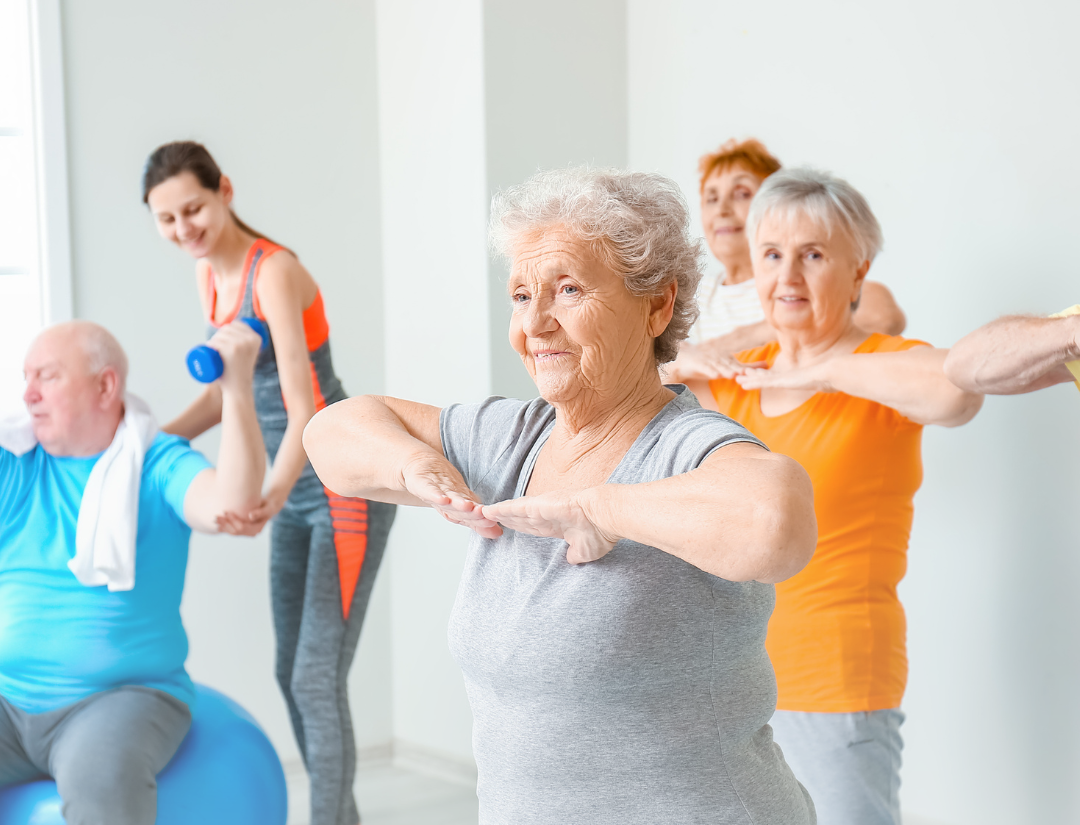
The Kritz review also found that how a group is run matters. Simply exercising in the same room is not the same as being part of a group where the leader builds shared goals and a sense of belonging. When choosing a class, look for small numbers, a leader who knows each person's goals, and a group that stays together long enough for people to get to know each other.
Will I Be the Least Fit Person There?
No. Every Back2Basics exercise has easier and harder versions, so two people can work on the same movement at very different levels in the same class.
You do not need to match anyone else's weight, repetitions or range, and you move up a level when you are ready, not when the rest of the class does.
Here is how one movement, the squat, can progress:
1. Sit to stand from a high chair, using your hands for support. Suits someone who finds getting out of a chair difficult.
2. Sit to stand from a standard chair with arms crossed. Suits someone building leg strength.
3. Bodyweight squat to a low box. Suits someone steady and comfortable at level 2.
4. Squat holding a weight at chest height. Suits someone returning to the gym or to heavier lifting at home or work.
The exercises work on four areas that everyday life depends on: strength for lifting, carrying and stairs; mobility for stiff joints; balance and coordination for steadier footing; and movement confidence, learning how your body responds to load, which can reduce the worry that movement will cause harm.
What Our Class Members Say
Lesley, a Back2Basics class member, says the biggest changes have been her balance and her confidence.

“Probably the biggest benefits for me have been my balance and my confidence.
Before coming to the classes, I struggled with walking because of the pain, and I think that affected my confidence too. Since doing the classes, I feel more confident with walking, and I’ve noticed that my knees feel a bit better after the classes as well.
I think what’s really good about the classes is that you keep an eye on everything we’re doing. I feel like I’m being supported and that you know when I’m struggling or when I can progress something.
That gives me confidence that I can improve and do more than I thought I could.”
Lesley, Back2Basics class member. Her experience is her own; results vary from person to person.
What Happens in a Back2Basics Programme?
1. Book a consultation. Patrick reviews your medical history, symptoms and goals, and may carry out an examination. This is required if you are not already receiving chiropractic care at the clinic.
2. Try your first class free. See the format and meet the group before committing.
3. Choose a block. Start (6 sessions), Build (12 sessions) or Thrive (24 sessions), with a lower price per session on longer blocks.
4. Train and progress. Exercises are stepped up as your strength and confidence grow.
Is It Normal for Exercise to Feel Uncomfortable at First?
Some muscle soreness is normal when you start a new activity with muscle or joint pain, and it does not usually mean you have done any harm.
Moving Medicine, the patient resource from the Faculty of Sport and Exercise Medicine UK, gives the same advice: start at a comfortable level and build up gradually. Muscles and joints that have done less for months often feel sore for a day or two after new work.
Supervision helps here. You can tell Patrick how you felt after the last session, and he can adjust the load, range or exercise choice rather than leaving you to guess.
Stop and tell the class lead straight away if you notice:
• Chest pain, fainting, or severe or unusual shortness of breath
• New numbness, tingling or weakness in the arms or legs
• A new pain or swelling, or pain that stops you moving
• Pain that keeps getting worse over several days rather than settling
Group Exercise Class or One-to-One Rehab: Which Is Better for Pain?
A group class suits people who want structure, supervision and company at a lower cost per session. One-to-one rehabilitation suits people who need a fully tailored programme.
Option | Best when | Trade-off |
You want guidance, a routine and company, and your goals overlap with others' | Less individual attention in each session | |
Your pain is complex, or you need a programme built around one specific goal | Higher cost per session | |
Exercising alone | You already know which exercises suit you and how to progress them | No one to check your form or adjust the load |
If you are unsure, the consultation is where that decision is made. Patrick can recommend the class, one-to-one work, or a referral elsewhere if exercise is not the right first step for you.
How Much Do Exercise Classes for Back and Joint Pain Cost in Cardiff?
Classes cost between £10 and £14 per session depending on the block you choose, and your first class is free.
An initial consultation costs £50 if you are not currently receiving chiropractic care at the clinic. Prices are correct as of October 2026.
Block | Sessions | Price | Per session |
Start | 6 | £84 | £14 |
Build | 12 | £144 | £12 |
Thrive | 24 | £240 | £10 |
Who Should Speak to a GP First?
Speak to your GP or NHS 111 before joining a class if your pain started after an accident, fall or injury, or if it comes with warning signs.
These include:
• Numbness, tingling or weakness spreading into both arms or the legs
• Symptoms that are getting steadily worse
• Pain that wakes you at night and does not ease with changing position
• Fever, feeling generally unwell or unexplained weight loss
The Back2Basics consultation includes these checks, and we refer people on when they appear.
Book Your Back2Basics Consultation
You do not have to wait until your pain has gone before you start building strength and confidence.
If you're looking for exercise classes for back & joint pain in Cardiff we can help. Book a consultation online, or contact us on 029 2061 7700 to ask for a call back from Patrick if you would like to talk it through first. Bring a short list of the everyday tasks you find hardest, because that list is the most useful starting point for your programme. You can also meet our team before you visit.
References
• O'Keeffe M, Hayes A, McCreesh K, Purtill H, O'Sullivan K. Are group-based and individual physiotherapy exercise programmes equally effective for musculoskeletal conditions? A systematic review and meta-analysis. British Journal of Sports Medicine. 2017;51(2):126-132. Read the paper
• Gómez-Redondo P, Valenzuela PL, Morales JS, et al. Supervised versus unsupervised exercise for the improvement of physical function and well-being outcomes in older adults: a systematic review and meta-analysis of randomized controlled trials. Sports Medicine. 2024;54:1877-1906. Read the paper
• Kritz M, Riddell H, Olsen D, et al. Individual versus group-based interventions: a systematic review and meta-analysis of physical activity, functional, psychosocial and health outcomes. Nature Human Behaviour. 2026;10:1109-1121. Read the paper
National Institute for Health and Care Excellence. Low back pain and sciatica in over 16s: assessment and management (NG59). Read the guideline


